Latest Science News
Jun 12, 2016
The Akamai Workforce Initiative, a local program dedicated to advancing Hawai‘i college students into science and technology careers, has accepted 30 students into its 2016 summer internship program. With lead funding from the Thirty Meter Telescope, the Akamai Internship Program provides community college students and undergraduates with summer projects at observatories and other high tech companies in Hawai‘i. All 30 students are from Hawai‘i or are enrolled at a University of Hawai‘i campus, and nearly half are of native Hawaiian ancestry. The students receive credit from UH Hilo and begin on Monday, June 13, 2016, with a preparatory course taught by Akamai instructors. They will then complete a seven-week project at various observatories and facilities on Hawai‘i Island and Maui. The Akamai Workforce Initiative is designed to build tomorrow’s high-tech workforce by providing support to local college students over a broad range of science, technology, engineering and mathematics (STEM) fields. Each student is matched with a mentor and is integrated as a member of the mentor’s group with daily guidance. Akamai mentors are prepared to provide an experience that will support their intern’s persistence in STEM, while they complete a real project valued by their host organization, through a unique workshop offered in May. The careful attention to mentoring, the preparatory course, and an ongoing communication course, are all important elements of the program and have been attributed to the program’s success. This year’s interns and their placements include: Maveric Abella Hnu Photonics, Maui Dutch Akana University of Hawai‘i at Hilo, Hawai‘i Island Daryl Albano Canada-France-Hawai‘i Telescope, Hawai‘i Island Jaren Ashcraft Institute for Astronomy, Maui Gregory Balinbin Integrity Applications... read more
Jun 11, 2016
MAUNAKEA, Hawaii – Astronomers using the W. M. Keck Observatory on Maunakea, Hawaii have obtained the most precise measurement yet of how fast the universe is expanding at the present time, and it doesn’t agree with predictions based on other data and our current understanding of the physics of the cosmos. The discrepancy – the universe is now expanding 9 percent faster than expected — means either that measurements of the cosmic microwave background radiation are wrong, or that some unknown physical phenomenon is speeding up the expansion of space, the astronomers say. The results, using data from Keck Observatory and the Hubble Space Telescope, will appear in an upcoming issue of The Astrophysical Journal. “If you really believe our number – and we have shed blood, sweat and tears to get our measurement right and to accurately understand the uncertainties – then it leads to the conclusion that there is a problem with predictions based on measurements of the cosmic microwave background radiation, the leftover glow from the Big Bang,” said Alex Filippenko, a UC Berkeley professor of astronomy and co-author of a paper announcing the discovery. Using the Keck-I 10-meter telescope in Hawaii, Filippenko’s group measured the chemical abundances of gases near the locations of Cepheid variable stars in the nearby galaxies hosting Type Ia supernovae. This allowed them to improve the accuracy of the derived distances of these galaxies, and thus to more accurately calibrate the peak luminosities of their Type Ia supernovae. “We’ve done the world’s best job of decreasing the uncertainty in the measured rate of universal expansion and of accurately assessing the size of this uncertainty,” said Filippenko, “yet we... read more
Local Events
Jul 18, 2016
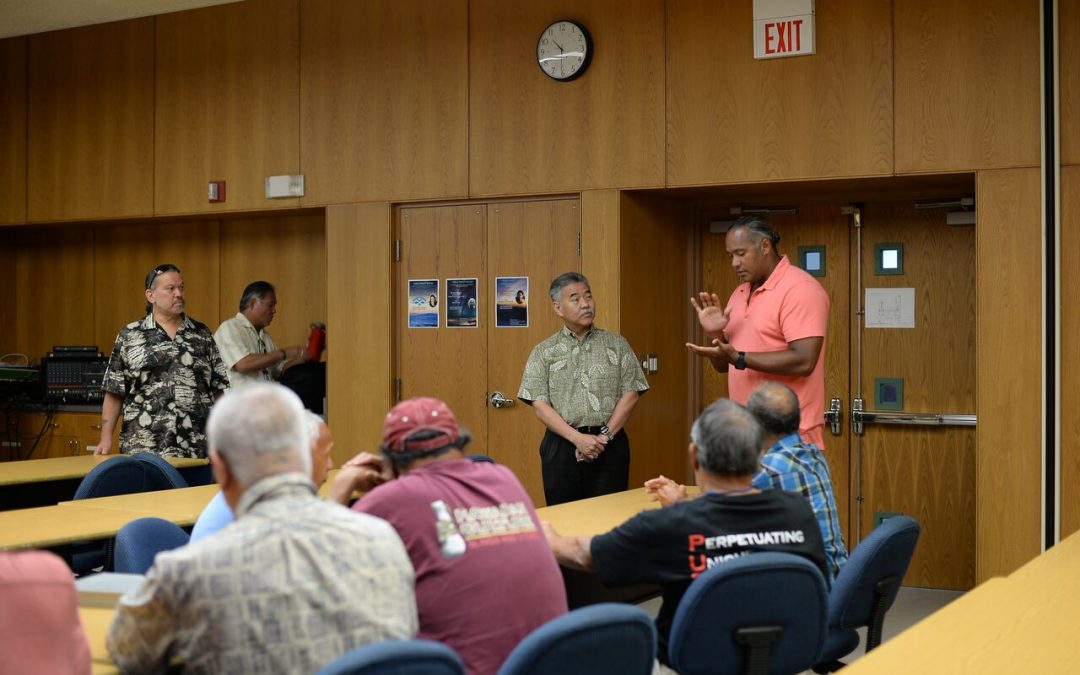
Governor Ige met briefly with leaders of PUEO to explain their role in the community and the types of educational and cultural opportunities each member has been providing and how they would like to see programs expanded in the future. This includes programs that are not just astronomy related. Keahi Warfield, president of PUEO, expressed how important it was to have a range of scientific fields participating in the educational process. His desire is to offer programs spanning educational fields from the ocean to the mountaintops. It’s very important to have options for kids so they can pursue the activities they find interesting. Perhaps they’re more interested in hunting and Wildlife and Game Management might be what they prefer to study. We need more educational fields like Fisheries, Geology, Biology, as well as Astronomy, Math and Physics. These are the types of programs we want to build for the next generations. Governor Ige listened intently as each member discussed their background and their vision of how to move the people of Hawaii forward, away from homelessness, drugs and poverty through creating educational opportunities. In addition they stressed that longterm plans are needed to create new industries that would help prevent the “Brain Drain” of Hawaii’s youth where they leave for better education and jobs. The meeting was opened up to the astronomy community where multiple students and teachers spoke of the unique educational opportunities that led them to become interest in scientific fields. They also discussed how they see the construction of the Thirty Meter Telescope (TMT) as a key part of increasing Hawaii’s role in leading science and... read more
Jul 13, 2016
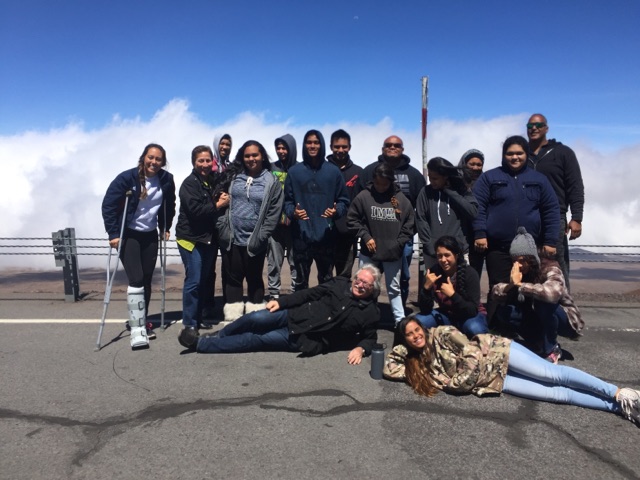
Keahi led our second educational trip up to Mauna Kea for PUEO kids was yesterday! Mahalo to Guenther Hasinger, Astronomer and UH Institute for Astronomy Director who helped guide the group visit to the top and NASA’s Infrared Telescope Facility, W. M. Keck Observatory, and the 2.2m UH Telescope. Guenther also gave a presentation about astronomy, careers and history of telescopes at Hale Pohaku. Educational opportunities like these are priceless. Everyone had a lot of fun too while learning Maunakea’s role in leading the world’s scientific discoveries and how they can play a critical part in the... read more
